

When Accuracy Starts to Look Like Weakness
The hidden cost of leadership uncertainty
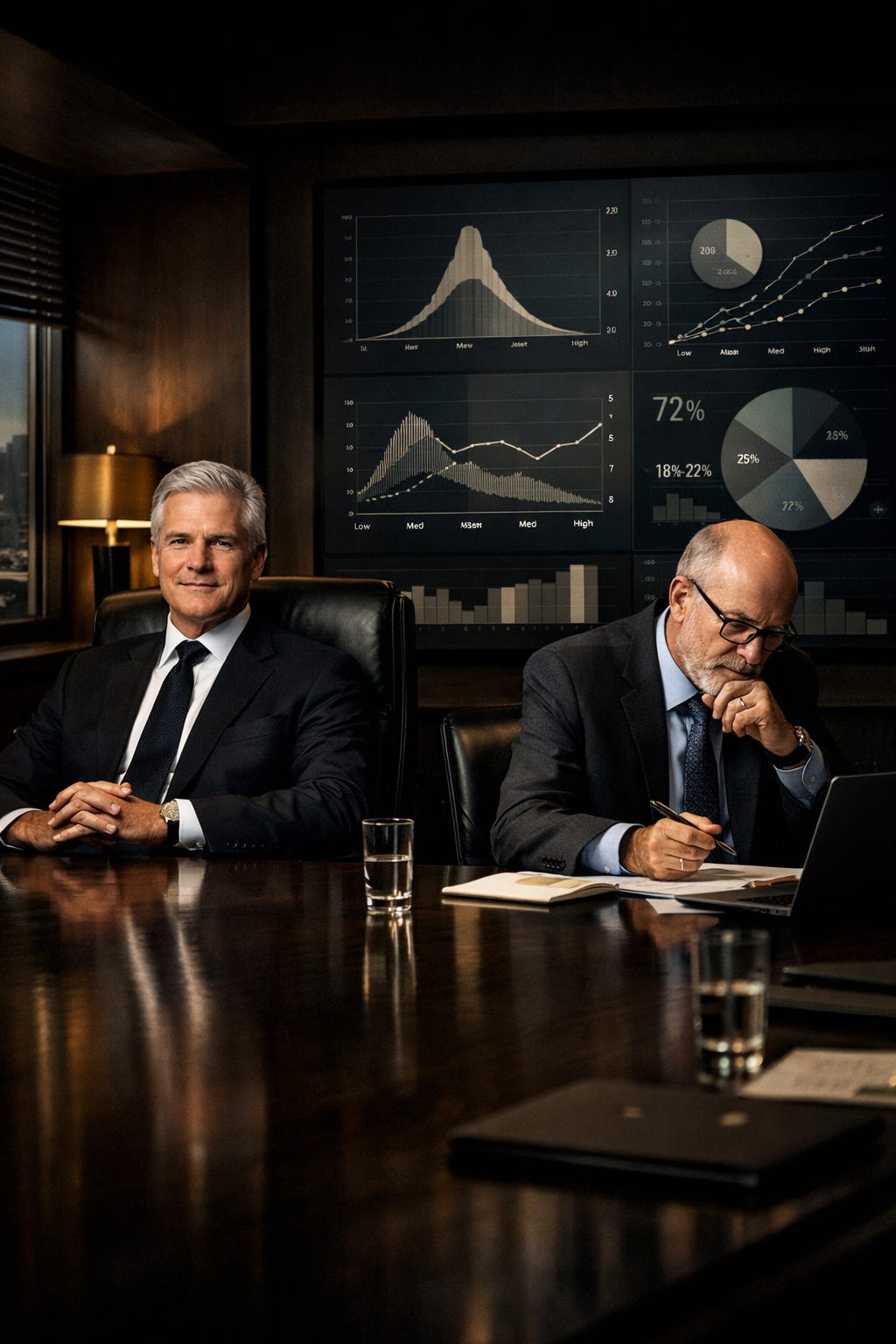
A senior leadership meeting in February 2026.
One executive says: we are looking at three risk bands, the expected outcome depends heavily on several factors, and there are also two points in the regulatory environment that could quickly change the picture, so we need to work with several scenarios.
Another says: the basic situation has not changed, the market is open. But the window is closing, and the competitor will get there before us if we hesitate. The pressure to act is greater than the uncertainty. We need to decide.
The second intervention projects more control. It sounds firmer, and signals more clearly that someone has a hand on the wheel. Decision research has long shown that confidently delivered judgements are often perceived as more competent and more credible, even when their objective accuracy is no higher. In group decision settings, more confident speakers can gain greater influence partly independently of their actual competence, and confidence itself can raise perceived competence.
More accurate analysis usually appears in a different form. It does not come as a single forceful sentence, but as assumptions, sensitivities, probability ranges, dependencies and constraints. It often speaks more cautiously. In the same situation, the firmer statement more readily signals direction and control.
This is visible in investment and capital allocation decisions as well. The possibility of a worse outcome may be present, yet still carry less weight than the full risk picture would justify. The decision may still be the right one. Research suggests that CEO overconfidence can, in some contexts, be associated with stronger firm performance, partly through greater strategic risk-taking. The question, then, is not whether the more decisive choice is automatically the worse one. It is how far the weighting is being shaped by the situation itself, and how far by the form in which it is presented.
The same dynamic appears in risk management in a different form. Early warning signals often land weakly inside organisations. They are fragmentary, conditional, and rarely sound as clear-cut as a fully formed recommendation or a strong assertion. Research has consistently shown that uncomfortable or risky information can lose force as it moves through an organisation, especially when speaking up carries personal or reputational cost.
A similar process shapes the distribution of influence. Over time, authority tends to grow around those who can speak about the same situation in a firmer, more action-oriented — in other words, more recognisably leader-like — way. Organisational credibility and influence are built in part through how someone speaks and the situation in which they speak. The quality of the leader–member relationship, and trust in leadership, complicate this picture further.
There is another cost in strategic adaptability. The more forcefully, clearly and authoritatively a direction has been set, the harder it becomes to revise it later without visible loss. At that point, correction no longer looks like professional recalibration. It looks like retreat. The organisation becomes less willing to return not only to the more accurate analysis, but also to the correction that may later be required.
Certain conditions strengthen this dynamic. Strong hierarchy does. High external visibility and high reputational stakes do. Time pressure does. So do cultural norms that equate confidence too readily with competence.
In that environment, certainty fits easily with prevailing expectations of leadership. Probabilistic thinking, by contrast, can start to look like hesitation or weakness.
Leadership still requires decisiveness. Strategic direction still requires commitment. The crucial distinction is this: direction can be clear without overstating what is actually known. A leader can give a clear steer while still speaking openly about assumptions, sensitivities and alternative scenarios. The problem begins when the organisation can no longer handle that distinction properly, and starts to treat calibrated uncertainty not as professional seriousness, but as a reputational burden.
The decline in decision quality does not come from one dramatic mistake. It comes from a pattern: the organisation rewards the forceful, rapid intervention over the more accurate, more careful analysis. The cost then works its way into capital allocation, the visibility of risk, the structure of influence and the organisation’s capacity to correct course. Once accuracy starts to look like weakness, the organisation begins to undermine the quality of its own decision system.
This belongs to corporate governance, not to the margins of communication style. The real question is what form of uncertainty a leadership setting can absorb without downgrading the speaker. If there is no room in the organisation for sentences that do not sound simple because the situation itself is not simple, then sooner or later it will stop rewarding the better judgement and start rewarding the better-sounding certainty.
Sources
Anderson, C., Brion, S., Moore, D. A., & Kennedy, J. A. (2012). A status-enhancement account of overconfidence. Journal of Personality and Social Psychology, 103(4), 718–735.
Burkhard, B., Jansson, A., Michaely, R., & Oesch, D. (2022). CEO overconfidence and corporate performance: A meta-analysis. Journal of Financial Economics, 146(2), 471–493.
Detert, J. R., & Edmondson, A. C. (2011). Implicit voice theories: Taken-for-granted rules of self-censorship at work. Academy of Management Journal, 54(3), 461–488.
Dirks, K. T., & Ferrin, D. L. (2002). Trust in leadership: Meta-analytic findings and implications for research and practice. Journal of Applied Psychology, 87(4), 611–628.
Graen, G. B., & Uhl-Bien, M. (1995). Relationship-based approach to leadership: Development of leader-member exchange (LMX) theory of leadership over 25 years: Applying a multi-level multi-domain perspective. The Leadership Quarterly, 6(2), 219–247.
Kennedy, J. A., Anderson, C., & Moore, D. A. (2013). When overconfidence is revealed to others: Testing the status-enhancement theory of overconfidence. Organizational Behavior and Human Decision Processes, 122(2), 266–279.
Milliken, F. J., Morrison, E. W., & Hewlin, P. F. (2003). An exploratory study of employee silence: Issues that employees don’t communicate upward and why. Journal of Management Studies, 40(6), 1453–1476.
Morrison, E. W. (2023). Employee voice and silence: Taking stock a decade later. Annual Review of Organizational Psychology and Organizational Behavior, 10, 79–107.
Zarnoth, P., & Sniezek, J. A. (1997). The social influence of confidence in group decision making. Journal of Experimental Social Psychology, 33(4), 345–366.