

Over my morning coffee, I came across a post from an organisation that publishes on workplace issues and ethical AI: “If even Google doesn’t trust AI with hiring, why should we?”
The headline quickly digests the story and serves it back to the reader, with all the professional precision and intellectual humility one might expect from the subject. Or perhaps not.
The post points to an article in HR Portal, an HR publication, whose headline already knows the answer: “Google developers warn: AI wrongly filters out applicants” (HR Portal, 2026).
There is a real story behind it. Google DeepMind’s AGI Safety and Alignment team provided applicants with an additional form because, according to an internal document, there was a non-negligible chance that a CV could be incorrectly filtered out by the application system, or take too long to reach the team. The form was intended to ensure that an actual member of the team saw the application.
The original Bloomberg report also includes a response from a Google DeepMind spokesperson. The spokesperson disputed that the system was wrongly filtering out internal applicants and said that the additional form was designed to bypass recruiter review and send CVs directly to the team. So, in this particular story, one element of the human safety net involved bypassing another human (Love, 2026).
Well, that part remained rather well concealed behind the polished HR-expert costume.
AI can make mistakes, therefore we need a human — or perhaps we could pull ourselves a little closer to reality:
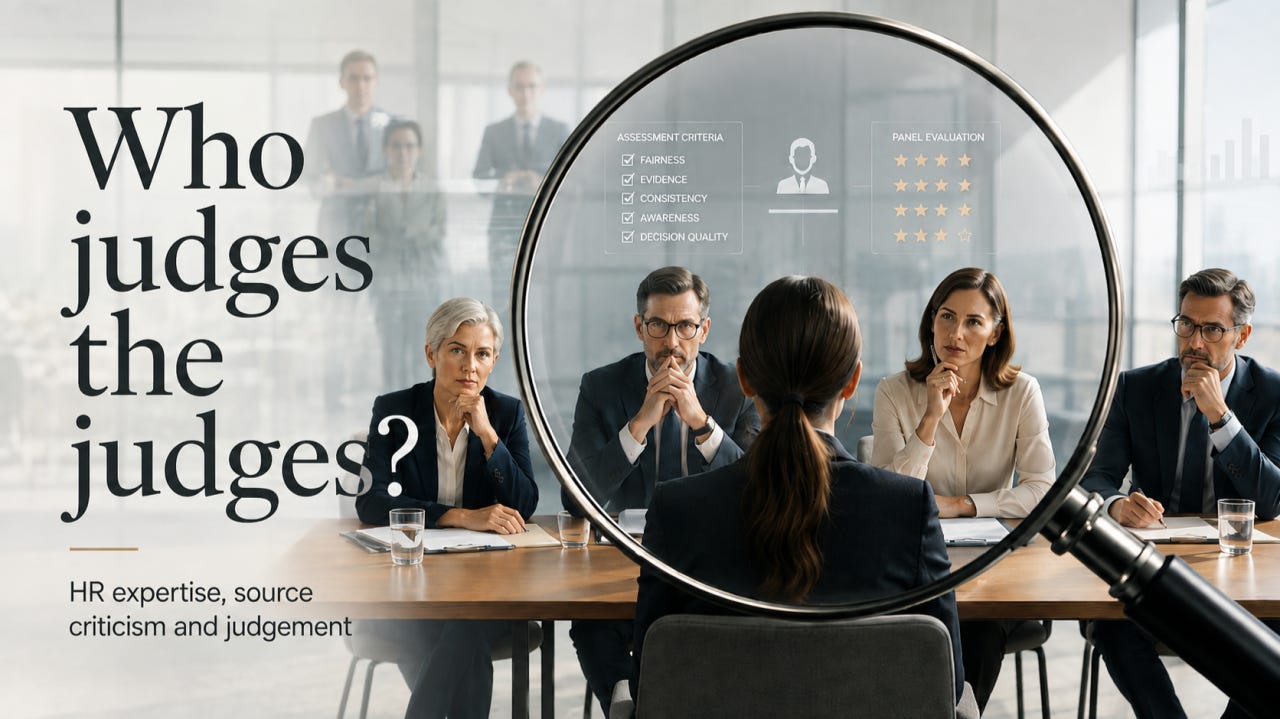
The quality of human judgement in selection is hardly self-evident. We have decades of research showing that the same candidate can be evaluated differently because of their name, sex, background, the impression they create in an interview, or simply the evaluator’s own preferences. Poor human selection decisions have a considerably longer history than AI. This does not rule out AI finishing the race badly too. If it does, the reasons need to be examined.
“Human-in-the-loop” guarantees very little by itself. Which human? What do they see? What criteria do they use? Does anyone check whom they reject incorrectly? Do we actually know how well a recruiter’s judgement predicts who will perform well in the job?
Mention AI and we immediately start talking about bias, error rates and auditability. Meanwhile, “AI” itself is allowed to remain some sort of mystical black box. A CV-ranking system? A generative model? An autonomous AI agent capable of carrying out multiple steps independently? Under one convenient label sit very different tasks, decision rights and sources of error. Perhaps the same degree of precision would be useful when examining human HR decisions.
Experts in the net
It is surprising that an HR publication needs this kind of net to catch readers. Look at major HR events and we appear to be overflowing with HR experts. At least according to the business cards. Often generously decorated with one academic qualification or another.
One HR Portal article is obviously not a representative survey of the state of HR. It is, however, quite useful for showing what level of content can enter and circulate through that environment without much difficulty.
Does anyone actually make use of all that at least presumed expertise? Or is a conversation in a nice outfit enough, with half the time spent praising each other’s achievements and the rest composing a creative platter from low-hanging fruit?
Because if all this expertise still fails to produce the question of how and to what extent human, AI-based or even autonomous AI-agent-led selection can be considered reliable, lack of experts does not look like the most likely explanation.
If someone calls themselves an HR expert, it seems a fairly rational expectation that they follow developments in their field, continue learning and have access to what can currently be known about their own subject. How well a genuinely articulate expert would complement the suit, make-up and business card: someone working from current knowledge, capable of drawing their own conclusions and thinking critically.
Are HR programmes in 2026 at the point where the ability to read international literature — and, even more importantly, the desire to do so — is considered part of professional intelligence? Anyone who gains access to current research only after somebody else has translated, summarised or retold it necessarily builds their knowledge through somebody else’s selection and interpretation.
Stories told by students or candidates can be interesting and current. They do not replace the literature. We do not always know how accurate they are, what has been omitted, or how much has been distorted by intention or interpretation.
Expert status presupposes access to original sources and the ability to check for yourself what your claims are built on before passing them on to others.
Pre-chewed food makes digestion easier, but credibility gets absorbed on the way down.
Are we at the point where someone publishing in an HR outlet is expected to read the original source, retain relevant counterpoints and refrain from making claims stronger than the source itself? Or do clickable headlines and easily digestible stories make a little distortion acceptable while the industry’s standards continue to sink?
The question is whether we are already discussing this from the basement.
And if, in a post by an organisation that publishes guidance and commentary on ethical AI, opinion, ethical judgement and fact are presented with the same degree of certainty, how confidently should people rely on the usefulness of that guidance?
A little off-topic for this particular post, but I do wonder how many HR experts — academics or practitioners — occasionally sit with this question honestly and with some serious self-criticism: when they assess other people’s expertise, suitability and preparedness, what sources, how current a body of knowledge, and how much self-scrutiny does their own expertise rest on?
Sources
HR Portal. (2026). Google fejlesztői figyelmeztetnek: az AI tévesen szűri ki a jelentkezőket. HR Portal – full article
Love, J. (2026, August 10). Google’s AI Team Tells Job Seekers Its HR Filters Are Unreliable. Bloomberg. Bloomberg article – syndicated by Yahoo Finance
Lilien Gerlach
Behavioural Analyst | Organisational Behaviour | Author | Speaker