


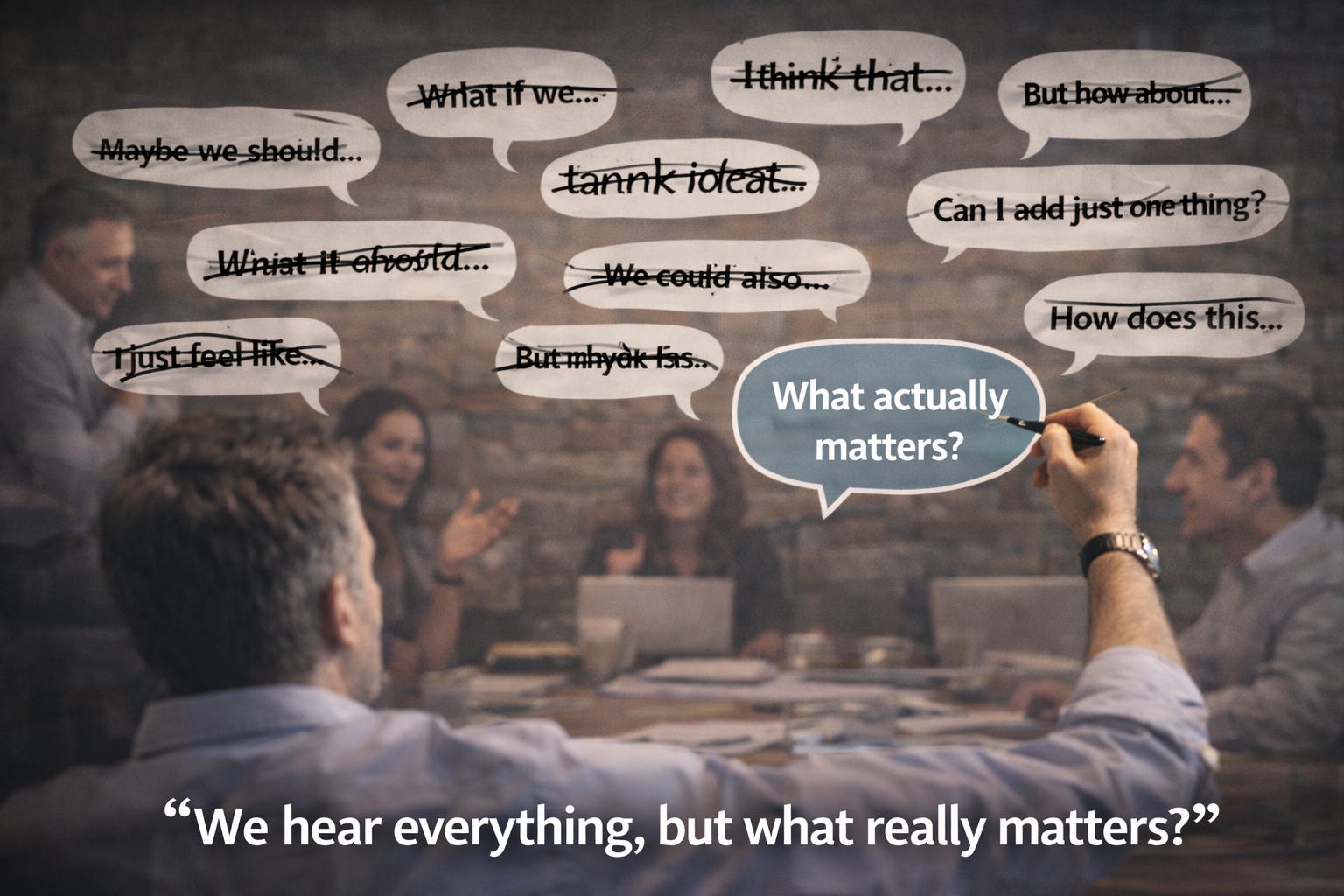
In a crisis, organisations often instinctively turn to the jovial leader. The one who reassures, keeps the connection alive, responds to every contribution, and lowers the emotional temperature in the room. This is understandable. Uncertainty produces anxiety, and joviality is one of the fastest ways to reduce it.
The problem is not bad intent.
The problem is that joviality optimises for a different function than a crisis requires.
At the level of behaviour, joviality expands the conversational field. It invites more contributions, more reactions, more partially formed thoughts. The leader responds, connects, smooths, and keeps the relational flow moving. In stable environments this can be effective. In a crisis, however, it has a side effect: it increases interactional noise.
In a crisis, the core question is not whether everyone has spoken, but which information actually matters. Jovial leadership encourages people to speak more, explain more, and reassure more. Not because discipline is absent, but because the situation allows expansive communication.
This slows decision-making.
A crisis is not a democratic information-gathering exercise. Decisions do not improve because more voices are present, but because irrelevant signals are filtered out. Joviality tends to keep those signals in play.
There is a second, less visible effect. Jovial leaders often continue “holding the connection” even after the situation has shifted from exploration to decision. They ask follow-up questions, refine phrasing, open additional loops. This lowers tension, but it also delays closure of responsibility. In a crisis, that delay can be decisive.
By contrast, leaders who are later described as charismatic are often not more pleasant. They do not respond to every contribution or immediately fill silence. Behaviourally, they narrow the field: fewer contributions are made, but each carries more weight.
This does not work because of personality strength. It works because the situation demands a reduction of interactional options. Fewer paths remain open, and decisions emerge faster.
None of this implies that jovial leaders are poor leaders. It only shows that joviality is not optimised for crisis conditions. It builds connection and psychological comfort, but it does not select. In a crisis, selection matters more than comfort.
The question, then, is not who is jovial and who is charismatic.
The question is which behavioural effect a given situation requires.
In a crisis, decisions do not improve because everyone feels better in the room.
They improve because fewer things happen — and those that do, matter more.